Best Physiotherapy Clinic in Sector 1, Greater Noida West for Bell's Palsy and Facial Paralysis
Dr. Mukul (PT) Founder & Lead Physiotherapist
Prem Advance Physiotherapy
Serving residents of Ajnara Le Garden · Casa Greens · Saya Zion · Sector 16C · Sector 1 · Greater Noida West
Sector 1, Greater Noida West · +91 8130036806 / +91 8750529606
Prem Advance Physiotherapy
Serving residents of Ajnara Le Garden · Casa Greens · Saya Zion · Sector 16C · Sector 1 · Greater Noida West
Sector 1, Greater Noida West · +91 8130036806 / +91 8750529606
It tends to arrive overnight. You brush your teeth and the water escapes from one corner of the mouth. One eye does not close fully. A smile in the mirror pulls to a single side. Understandably, the first thought for almost everyone is that this is a stroke, and the drive to a hospital happens fast.
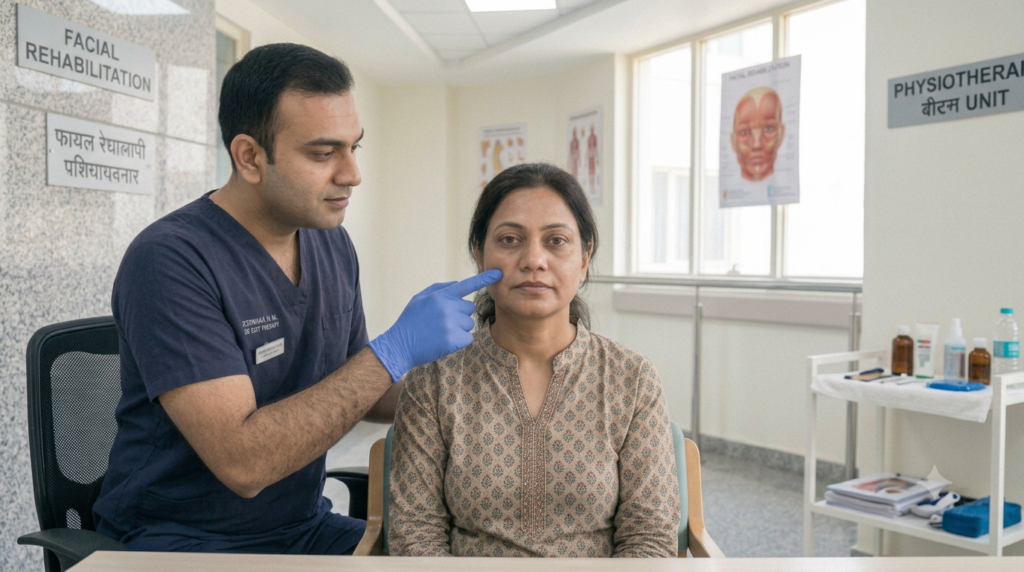
Most of the time, once that has been ruled out, the diagnosis is Bell’s palsy: a sudden weakness of the facial nerve on one side, usually with no identifiable cause. At Prem Advance Physiotherapy and Rehabilitation Center, facial nerve rehabilitation is handled as careful neuromuscular retraining under Dr. Mukul (PT), not as a set of facial exercises to repeat at home until things improve.
What Causes Bell's Palsy and Facial Nerve Weakness?
The facial nerve controls the muscles of expression on one side of the face, along with tear production, part of the sense of taste, and a small muscle that dampens loud sound. It travels through a narrow bony canal near the ear, which is why swelling anywhere along that path compresses it quickly and produces weakness out of proportion to the cause.
Bell’s palsy affects the whole side of the face, forehead included. That detail is clinically important. A stroke affecting the face usually spares the forehead, because of how the nerve pathways are wired above the level of the facial nerve nucleus. Anyone who cannot lift the eyebrow on the weak side is more likely dealing with a facial nerve problem than a brain one, but this is a distinction for a doctor to confirm, not for a patient to make alone.
Recovery follows the nerve’s own timeline. Where the nerve is only compressed and not damaged, function often returns within weeks. Where fibres have degenerated, regrowth is slow, roughly a millimetre a day, and rehabilitation becomes a matter of months rather than weeks.
Bell's Palsy Symptoms: When to See a Doctor Immediately
Expected pattern
- Weakness on one side of the face, forehead included
- Onset over hours to a day or two, then stable
- Some ache behind the ear before or around onset
- Altered taste or sensitivity to loud sound on that side
- Gradual improvement beginning within two to four weeks
Needs urgent medical attention
- Weakness in the arm or leg alongside the face
- Slurred speech, confusion or sudden severe headache
- Facial weakness that spares the forehead
- Both sides of the face affected
- Eye becoming red, gritty or painful
- No improvement at all after three to four months
Why Facial Exercises at Home Often Slow Recovery Down
The instinct with a weak muscle is to work it hard. With the face, that instinct causes problems. Forceful, repetitive grimacing and chewing gum for hours are among the most common self prescribed treatments, and they tend to encourage mass movement patterns rather than the fine, independent control that normal expression requires.
The second risk is the eye. When the eyelid does not close properly, the surface of the eye dries out, and a corneal injury during the recovery period is a genuine and avoidable complication. Lubricating drops, taping at night where advised, and protection outdoors matter more in the first fortnight than any facial exercise.
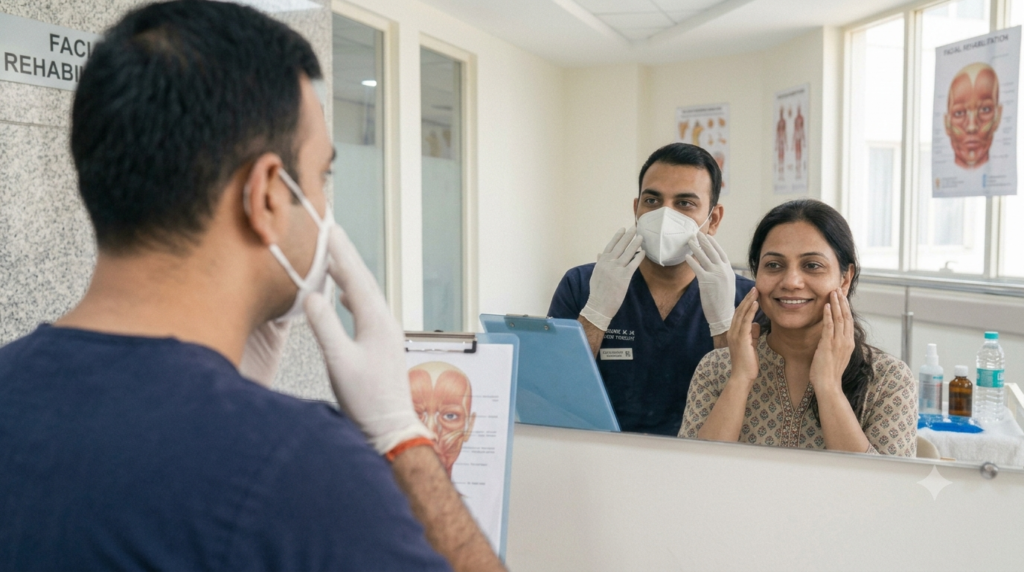
The third issue shows up later. As the nerve regrows, some fibres reach the wrong muscles, producing synkinesis: the eye narrowing when the person smiles, or the cheek twitching when the eyes close. Once established this is difficult to undo, which is why the early phase emphasises slow, controlled, mirror guided movement rather than maximum effort.
Bell's Palsy Recovery Timeline: What to Expect Week by Week
Patients almost always want a timeline, and a rough one is possible even though individual recovery varies widely. The staged approach below mirrors how other nerve conditions are handled in the clinic blog.
First two weeks Weakness is at its worst and may still be progressing slightly. Priority is medical treatment and eye protection, not exercise. Rehabilitation at this stage is mostly education and gentle facilitation.
Weeks three to six Most people who are going to recover quickly show the first flicker of return in this window. Low effort, mirror guided movement begins in earnest.
Months two to four Slower recoveries progress here as nerve fibres regrow. Movement quality matters far more than movement size, since this is when abnormal patterns can set in.
Beyond four months Where synkinesis has appeared, retraining shifts toward isolating movement and relaxing overactive regions. Persistent complete weakness at this point needs further medical review.
Bell's Palsy Treatment at Prem Advance Physiotherapy, Greater Noida West
Treatment follows a staged sequence rather than a fixed set of sessions, and it sits alongside the neurological and orthopaedic services offered here. Each stage is progressed on how the person is actually responding.
Assessment and grading of facial weakness Structured grading of movement in each region of the face, repeated over time, so that progress or lack of it is measured rather than guessed at from how a photograph looks.
Eye protection guidance Practical instruction on lubrication, night time protection and outdoor precautions while the eyelid closure is incomplete. This is the highest priority in the first two weeks.
Facilitation and gentle motor re-education Low effort, mirror guided movements that teach each region of the face to move independently. Deliberately quiet work, because effort recruits the wrong muscles.
Soft tissue work and stretching Manual work through the face and jaw to keep tissue mobile and reduce the tightness that builds when one side of the face has been inactive for weeks.
Synkinesis management in later stages Where abnormal linked movement has developed, retraining focuses on isolating movements at very low effort, along with relaxation strategies for the overactive regions.
Education and expectation setting Clear explanation of the likely timeline, which reduces a great deal of the anxiety this condition creates. The same approach used across neurological rehabilitation at the clinic.
Facial Paralysis Physiotherapy Near Ajnara Le Garden and Casa Greens
The clinic is in Sector 1, Greater Noida West, behind Ace City and Stellar Jeevan Society, within easy reach of Ajnara Le Garden, Casa Greens, Saya Zion and Sector 16C. Facial palsy patients usually arrive within days of onset, often after an emergency visit has ruled out a stroke, and are seen alongside their ongoing medical treatment rather than instead of it.
Where recovery is slower than expected, the team coordinates with the treating physician, since persistent weakness beyond a few months sometimes needs further investigation.
📍
View location on Google Maps
Tap to open directions
Shop No. 14/15, Gyanendra Jeevan Complex (Walking Street), Behind Ace City & Stellar Jeevan Society, Sector 1, Greater Noida West – 201306
Frequently Asked Questions: Bell's Palsy Physiotherapy Near Sector 1
Who is the best physiotherapist near Ajnara Le Garden and Saya Zion for Bell’s palsy?
Dr. Mukul (PT) handles facial nerve rehabilitation at the clinic in Sector 1, Greater Noida West, alongside other neurological conditions such as stroke and peripheral nerve injuries.
Does Bell’s palsy go away on its own?
A majority of people recover substantially, many within three to six weeks. Recovery is not universal though, and the people who do less well are usually those with severe weakness at onset. Guided rehabilitation matters most in exactly those cases, and it also protects the eye while the nerve is recovering.
How soon should physiotherapy start after facial weakness begins?
Medical review comes first, since medication started early influences outcome. Physiotherapy can begin within the first week alongside that, focusing initially on eye protection, gentle facilitation and education rather than heavy exercise.
Will electrical stimulation help my facial muscles?
It is used selectively rather than routinely. Current evidence is mixed, and in some presentations aggressive stimulation is thought to encourage abnormal nerve regrowth. Decisions are made case by case after assessment.
What is synkinesis and can it be treated?
Synkinesis is unwanted linked movement, for example the eye narrowing when you smile, caused by nerve fibres regrowing along the wrong pathways. It usually appears months after onset and responds to slow, precise motor retraining rather than strength work.
Is facial weakness always Bell’s palsy?
No, and this matters. Sudden weakness affecting the arm or leg as well, or facial weakness that spares the forehead, points to something other than Bell’s palsy and needs urgent medical review. Stroke related weakness is managed very differently.
How do I book an appointment for facial rehabilitation?
Call +91 8130036806, message the team on WhatsApp, or write through the website. Bringing any prescription or neurology notes from the first few days is useful.
Book a Bell's Palsy Physiotherapy Appointment in Sector 1, Greater Noida West
Waking up with half the face not working is frightening, and the internet does not help. The reassuring part is that most people recover well, and that the things which improve the odds are simple: prompt medical review, proper eye protection, and retraining that respects how slowly nerves actually regrow.
More about the clinical team, or reach out directly to arrange facial nerve rehabilitation at Prem Advance Physiotherapy and Rehabilitation Center.
Shop No. 14/15, Gyanendra Jeevan Complex (Walking Street), Behind Ace City & Stellar Jeevan Society, Sector 1, Greater Noida West – 201306 · +91 8130036806 / +91 8750529606 · WhatsApp · Contact · Services · Find us on Google Maps