Best Physiotherapy Clinic in Greater Noida West for Ankle Sprain and Ankle Instability
Dr. Mukul (PT) Founder & Lead Physiotherapist
Prem Advance Physiotherapy
Serving residents of Gaur City · Supertech Eco Village · Golf Avenue · Sports City · Sector 1 · Greater Noida West
Sector 1, Greater Noida West · +91 8130036806 / +91 8750529606
Prem Advance Physiotherapy
Serving residents of Gaur City · Supertech Eco Village · Golf Avenue · Sports City · Sector 1 · Greater Noida West
Sector 1, Greater Noida West · +91 8130036806 / +91 8750529606
Almost everyone has rolled an ankle at some point. Off a kerb near the market, on a badly lit patch of society pavement, coming down from a jump on a concrete court. It swells, it hurts for a week, and then life carries on. The trouble is what happens six months later, when the same ankle turns again on ground that should not have caused any problem at all.
That pattern of repeat twisting is the reason ankle sprains deserve more attention than they usually get. At Prem Advance Physiotherapy and Rehabilitation Center in Sector 1, Greater Noida West, Dr. Mukul (PT) treats a first sprain and a fourth sprain quite differently, because by the fourth one the problem has moved from the ligament to the way the ankle is being controlled.
What Causes an Ankle Sprain?
Most ankle sprains are inversion injuries. The foot rolls inward and the ligaments on the outer side of the ankle, particularly the anterior talofibular ligament, get overstretched. Grade one means the fibres are strained, grade two means partially torn, grade three means fully torn. Swelling and bruising tell you something about severity but not everything, since a mild sprain in a well vascularised ankle can look dramatic for a few days.
What matters more is what the ligament does besides holding bones together. It is dense with sensory receptors that tell the brain where the foot is in space. Damage the ligament and you damage that feedback line. The ankle may test strong and pain free, and still land badly on uneven ground, because the correction that should have happened in a fraction of a second did not arrive in time.
Ankle Sprain Symptoms: When to See a Physiotherapist Near Golf Avenue
Recovery on track
- Swelling reducing steadily after the first three or four days
- Able to bear weight and walk with a normal pattern within a week
- Ankle feels stable on flat ground and stairs
- Pain limited to the outer ankle and settling week on week
Worth having looked at
- Could not put any weight on the foot right after the injury
- Ankle gives way on ordinary ground, or has twisted more than twice
- Swelling still present after three to four weeks
- Sharp pain over the bone rather than over the soft tissue
- Pins and needles or numbness in the foot

Why Rest Alone Does Not Stop an Ankle From Giving Way
The standard advice after a sprain is rest, ice, compression and elevation, and for the first two or three days that is reasonable. The problem is that most people stop there. Once the pain settles they resume normal walking, call it healed, and never rebuild the two things that actually protect the joint: calf and peroneal strength, and single leg balance.
This is where the well documented figure comes in that a previous ankle sprain is the strongest predictor of the next one. It is not that the ligament stays permanently weak. It is that the control system around it was never retrained, so the ankle keeps meeting the ground in slightly the wrong position.
Chronic ankle instability also has knock on effects further up. People start subtly avoiding weight on that side, and over months that shows up as hip or knee discomfort with no obvious injury behind it.
Where Ankle Injuries Happen Across Greater Noida West Societies
Ankle injuries arriving at the clinic cluster around a small number of situations, most of them within a few minutes of home. Several of these overlap with the sports and joint problems described in the clinic blog.
Society badminton and basketball courts Landing from a jump or changing direction on a hard court surface accounts for a large share of the sprains seen from Gaur City, Supertech Eco Village and Golf Avenue.
Uneven internal roads and construction edges Kerbs, broken paver stretches and ongoing construction along the Noida Extension corridor produce the classic step-off-and-roll injury.
Evening runs on poorly lit stretches Reduced visibility removes the visual cue the ankle relies on to prepare for uneven ground, which is exactly the mechanism that catches people who have already sprained once.
Stairwells during power cuts Descending stairs in low light is the most common indoor mechanism, and it is over-represented among older residents.
Ankle Sprain Treatment at Prem Advance Physiotherapy, Greater Noida West
Treatment follows a staged sequence rather than a fixed set of sessions, and it sits alongside the full list of treatments available at the clinic. Each stage is progressed on how the person is actually responding.
Grading the injury and ruling out a fracture Clinical testing establishes which ligaments are involved and whether imaging is needed at all. Most sprains do not require an X-ray, but the ones that do should not be missed in the first week.
Early swelling control and protected movement Compression, elevation and gentle range of motion started early, rather than complete immobilisation, which leaves the joint stiff and the calf noticeably weaker within days.
Restoring ankle range of motion Particular attention to how far the knee can travel over the toes with the heel down. That movement is often quietly lost after a sprain, and it changes how the whole leg absorbs load on stairs and slopes.
Calf and peroneal strengthening Graded loading for the muscles running down the outside of the shin, which act as the ankle’s active brake against rolling inward.
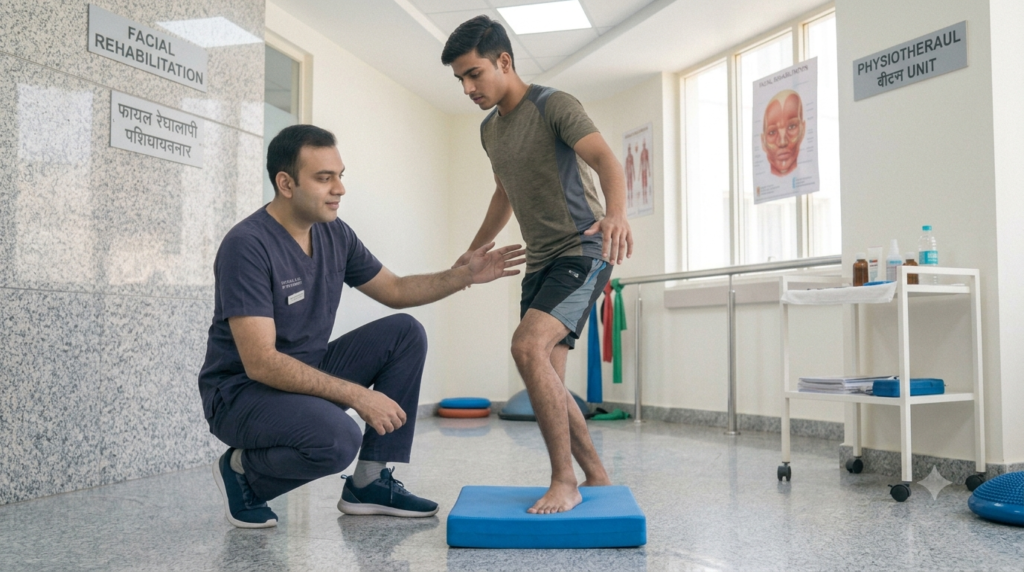
Balance and proprioceptive retraining Single leg work progressing from stable to unstable surfaces, then to eyes closed and reactive tasks. This is the stage that most home recovery skips, and the stage that most reduces repeat injury.
Return to running, court sport and daily terrain Hopping, cutting and landing drills before clearance, matching the same staged logic used in ligament rehabilitation at the knee.
Ankle Injury Physiotherapy Near Gaur City and Supertech Eco Village
The clinic is located in Sector 1, Greater Noida West, behind Ace City and Stellar Jeevan Society, and is easily reached from Gaur City, Supertech Eco Village, Golf Avenue and the Sports City stretch. Ankle injuries here arrive from a fairly predictable set of sources: society badminton and basketball courts, uneven internal roads and construction edges, evening runs on poorly lit stretches, and gym sessions where load went up faster than technique.
For an acute injury, coming in within the first week makes the early phase considerably easier to manage. For an ankle that has been rolling repeatedly for a year, the assessment shifts toward balance and strength testing rather than the ligament itself.
📍
View location on Google Maps
Tap to open directions
Shop No. 14/15, Gyanendra Jeevan Complex (Walking Street), Behind Ace City & Stellar Jeevan Society, Sector 1, Greater Noida West – 201306
Frequently Asked Questions: Ankle Sprain Physiotherapy Near Sector 1
Who is the best physiotherapist near Gaur City and Golf Avenue for an ankle sprain?
Dr. Mukul (PT) manages ankle sprains and repeat ankle instability at the clinic in Sector 1, Greater Noida West, with a graded programme covering swelling control, balance retraining and return to sport.
How long does a sprained ankle take to heal?
A mild ligament sprain settles in two to three weeks, a moderate one in four to eight. The ligament healing and the ankle being ready to trust are two different milestones, though, and balance usually lags behind pain by several weeks.
Should I walk on a sprained ankle or rest it completely?
Early protected movement generally beats complete rest. Prolonged immobilisation leaves the ankle stiff and the calf weak. How much weight to put through it in the first few days depends on how severe the sprain is, which is worth having assessed.
Why does my ankle keep twisting again on the same side?
Repeat sprains are usually a control problem, not a ligament problem. The position sense in the joint is blunted after the first injury, so the foot lands slightly wrong on uneven ground. Balance and strength retraining at the clinic in Sector 1 is what breaks that cycle.
Do I need an X-ray or MRI for an ankle injury?
Not for most sprains. Imaging is worth arranging when you could not bear weight at all immediately after the injury, when there is bony tenderness at specific points, or when swelling and pain are not settling as expected.
Does the clinic treat sports injuries other than ankles?
Yes. Ankle work sits alongside knee and ligament rehabilitation and broader sports injury management, since the same movement faults often show up across several joints.
How do I book an appointment for an ankle assessment?
Call +91 8130036806, send a WhatsApp message, or use the contact page. Morning and evening slots run six days a week.
Book an Ankle Sprain Physiotherapy Appointment in Greater Noida West
A sprained ankle that stops hurting is not the same as a sprained ankle that has recovered. If yours has turned more than once, or still feels unreliable on stairs and uneven ground, the gap is almost always in control and strength rather than in the ligament.
Learn about the clinical team or get in touch to have the ankle assessed at Prem Advance Physiotherapy and Rehabilitation Center.
Shop No. 14/15, Gyanendra Jeevan Complex (Walking Street), Behind Ace City & Stellar Jeevan Society, Sector 1, Greater Noida West – 201306 · +91 8130036806 / +91 8750529606 · WhatsApp · Contact · Services · Find us on Google Maps