Best Physiotherapy Clinic in Greater Noida West for Diabetic Neuropathy and Foot Care
Dr. Mukul (PT) Founder & Lead Physiotherapist
Prem Advance Physiotherapy
Serving residents of Panchsheel Hynish · Victory Ace · Amrapali Princely Estate · Sector 4 · Sector 1 · Greater Noida West
Sector 1, Greater Noida West · +91 8130036806 / +91 8750529606
Prem Advance Physiotherapy
Serving residents of Panchsheel Hynish · Victory Ace · Amrapali Princely Estate · Sector 4 · Sector 1 · Greater Noida West
Sector 1, Greater Noida West · +91 8130036806 / +91 8750529606
It rarely announces itself. First there is a bit of tingling in the toes at night. Then a slippers-on-a-cold-floor feeling that is not quite right. Then a day when a stone in the shoe goes unnoticed for hours, or a step off a kerb in the dark feels far less certain than it used to.
Diabetic peripheral neuropathy develops slowly enough that most people adjust around it without ever mentioning it at a check-up. At Prem Advance Physiotherapy and Rehabilitation Center in Sector 1, Greater Noida West, Dr. Mukul (PT) treats it as two connected problems: the discomfort itself, and the loss of balance and foot protection that quietly follows it.
What Causes Diabetic Peripheral Neuropathy?
Persistently raised blood sugar damages the smallest blood vessels supplying the peripheral nerves. The longest nerves suffer first, which is why symptoms almost always begin in the toes and work upward in a stocking pattern, often reaching the hands only much later.
The symptoms come in two flavours that sound contradictory but frequently coexist. There is the positive kind: burning, tingling, electric shock sensations, pain from bedsheets touching the feet. And there is the negative kind: reduced sensation, numbness, feet that feel disconnected from the ground. The second is more dangerous, precisely because it does not hurt.
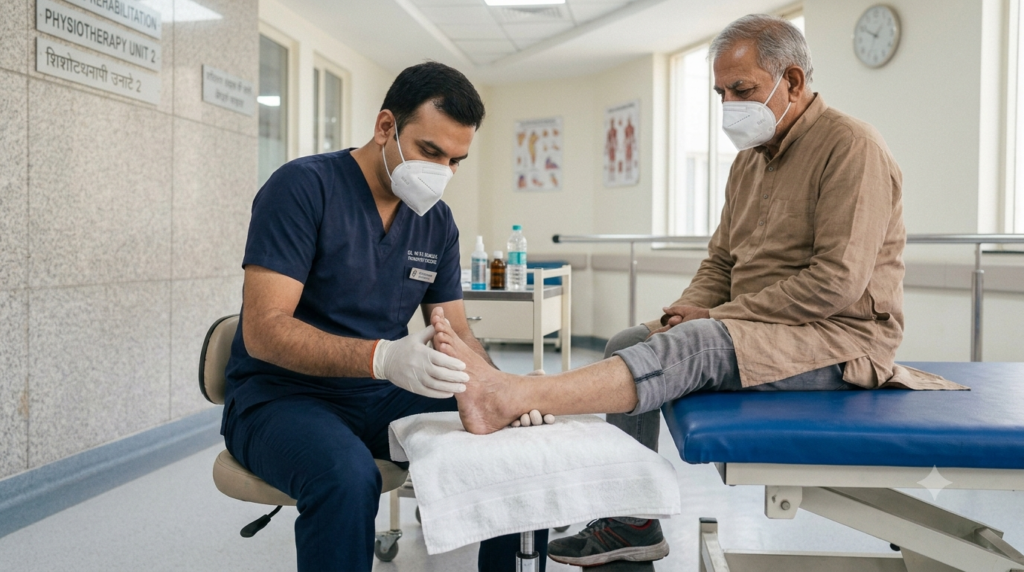
Alongside the sensory changes, the small muscles inside the foot weaken. Over time this alters the shape of the foot, raising the arch, clawing the toes, and shifting pressure onto areas that were never built to carry it. Those pressure points are where calluses and eventually ulcers form.
Diabetic Neuropathy Symptoms: When to See a Physiotherapist Near Sector 4
Early stage, manageable
- Occasional tingling in the toes, mostly at night
- Mild reduction in sensation but nothing missed underfoot
- Balance normal in daylight and on level ground
- Skin on the feet intact with no thickened pressure areas
Needs prompt attention
- Any cut, blister or ulcer on the foot, however small
- A stumble or fall in the last few months
- Losing balance in the dark, or feeling unsteady in the bathroom
- Colour change, coldness or swelling in one foot
- New thickened callus over a pressure point
- Burning pain that is disrupting sleep most nights
Why Medication Alone Does Not Fix Balance and Foot Risk
Medication can take the edge off neuropathic pain, and blood sugar control slows the underlying damage. Neither addresses what the reduced sensation has already done to balance and to the feet themselves.
Standing upright is a continuous correction task, and the sensors in the soles of the feet supply a large share of the information that makes it possible. As that input fades, the body leans harder on vision and the inner ear. This is why so many people with neuropathy report being fine during the day and distinctly unsteady at night, or wobbly the moment they close their eyes in the shower. It also explains why falls in this group are more common than the person’s general fitness would suggest.
The other half of the problem is protection. A foot that cannot feel a rubbing shoe, a hot floor, or a small cut loses its own alarm system. Regular inspection has to consciously replace what sensation used to do automatically, and that habit is taught rather than assumed.
Why Diabetic Foot Injuries Go Unnoticed in Greater Noida West Households
The foot problems that end up needing weeks of care usually begin with something small and painless. A few household patterns come up repeatedly, and they connect closely to the senior care topics covered in the clinic blog.
Walking barefoot indoors Hard tile and marble floors, along with the occasional stray object, cause cuts and pressure injuries that go completely unfelt when sensation is reduced.
Poorly fitting footwear Loose chappals and hard-soled shoes create friction points. Without pain to signal a problem, a blister progresses quietly over several days.
Winter heating habits Hot water bottles, room heaters and hot bucket water are a genuine burn risk when the feet cannot judge temperature accurately. This is seasonal and predictable.
Older parents living independently Where an elderly family member manages their own routine, feet may go uninspected for weeks. A daily check by a family member closes that gap more reliably than any device.
Diabetic Neuropathy Treatment at Prem Advance Physiotherapy, Greater Noida West
Treatment follows a staged sequence rather than a fixed set of sessions, and it sits alongside the geriatric and rehabilitation services available here. Each stage is progressed on how the person is actually responding.
Sensation and balance testing Baseline testing of protective sensation in the feet along with standing balance and walking assessment, so risk is measured rather than estimated. Repeating this over months shows whether things are stable.
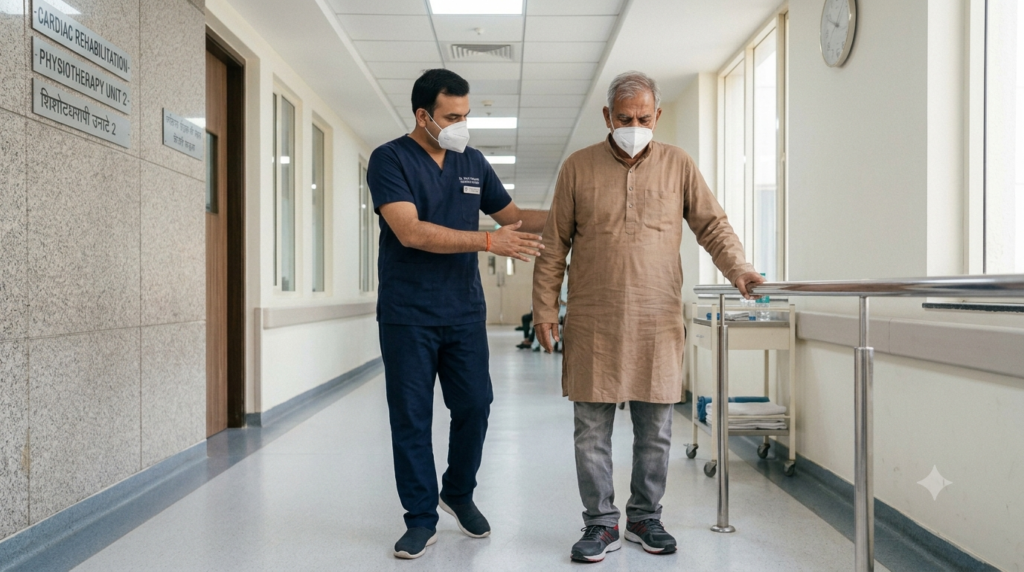
Balance and gait retraining Graded standing and stepping work that trains the body to use ankle and hip strategies more effectively when foot sensation is unreliable. This overlaps closely with fall prevention for seniors.
Foot and calf strengthening Targeted work for the intrinsic foot muscles and calf, which supports the arch, improves push off, and slows the deformity that shifts pressure onto vulnerable spots.
Aerobic conditioning within safe limits Walking or cycling programmes built around what the person can sustain, chosen with foot condition in mind. Regular activity supports circulation and blood sugar control together.
Foot care education Daily inspection routine, footwear guidance, and clear thresholds for when a mark on the foot needs a clinician rather than watchful waiting.
Pain management strategies Desensitisation techniques, activity pacing and positioning advice for the burning and hypersensitivity that medication does not fully settle.
Diabetic Neuropathy Physiotherapy Near Panchsheel Hynish and Victory Ace
The clinic is in Sector 1, Greater Noida West, behind Ace City and Stellar Jeevan Society, close to Panchsheel Hynish, Victory Ace, Amrapali Princely Estate and Sector 4. A large number of neuropathy referrals here come from families in the surrounding societies where an older parent has been living with diabetes for a decade or more, and where a recent stumble or a slow healing foot injury has finally prompted a visit.
Sessions run alongside whatever the treating physician has prescribed. Where a foot wound is present, the team adjusts weight bearing activity accordingly and keeps the physician informed rather than working independently.
📍
View location on Google Maps
Tap to open directions
Shop No. 14/15, Gyanendra Jeevan Complex (Walking Street), Behind Ace City & Stellar Jeevan Society, Sector 1, Greater Noida West – 201306
Frequently Asked Questions: Diabetic Neuropathy Physiotherapy Near Sector 1
Who is the best physiotherapist near Panchsheel Hynish and Victory Ace for diabetic neuropathy?
Dr. Mukul (PT) sees neuropathy patients at the clinic in Sector 1, Greater Noida West, combining balance training, strength work and foot care education alongside their ongoing medical management.
Can physiotherapy reverse diabetic nerve damage?
Physiotherapy does not regrow damaged nerves. What it reliably changes is the consequences: balance, walking confidence, calf and foot strength, circulation through activity, and the risk of a fall or an unnoticed foot injury. Blood sugar control remains the main lever on the nerve damage itself.
Why do my feet burn more at night?
Neuropathic pain often intensifies at night, partly because there is less distraction and partly because of how nerve signalling behaves with rest and temperature. It is a recognised pattern rather than a sign that something is deteriorating quickly.
Is exercise safe if I have numb feet?
Yes, with sensible choices. Weight bearing exercise is generally encouraged, but footwear needs to fit well and feet should be inspected daily, since a blister or pressure sore can go unnoticed when sensation is reduced. Activity selection is adjusted where there are existing foot ulcers.
How does neuropathy increase the risk of falling?
Balance depends heavily on sensation from the soles of the feet. When that input fades, the body relies more on vision and inner ear input, which is why unsteadiness worsens in dim light or on uneven ground. Fall prevention work directly targets this.
What foot checks should I be doing at home?
A daily look at the soles, between the toes and at the heels, using a mirror if needed. Any cut, blister, colour change or area of hardened skin that is not resolving should be shown to a clinician promptly rather than watched for a few weeks.
How do I book an assessment at the clinic?
Call +91 8130036806, use WhatsApp, or get in touch through the website. Bringing recent blood reports and a list of current medication helps the first session be more useful.
Book a Diabetic Neuropathy Physiotherapy Appointment in Greater Noida West
Neuropathy is usually framed as a sensation problem, but the outcomes that actually change someone’s life are falls and foot wounds. Both respond to work that can start at any stage, even years after the numbness began.
Read about the clinical team or get in touch to arrange a balance and foot assessment at Prem Advance Physiotherapy and Rehabilitation Center.
Shop No. 14/15, Gyanendra Jeevan Complex (Walking Street), Behind Ace City & Stellar Jeevan Society, Sector 1, Greater Noida West – 201306 · +91 8130036806 / +91 8750529606 · WhatsApp · Contact · Services · Find us on Google Maps