Best Physiotherapy Clinic in Sector 1, Greater Noida West for Breathlessness and Chest Physiotherapy
Dr. Mukul (PT) Founder & Lead Physiotherapist
Prem Advance Physiotherapy
Serving residents of La Residentia · Rudra Palace Heights · Prateek Grand City · Charms Castle · Sector 1 · Greater Noida West
Sector 1, Greater Noida West · +91 8130036806 / +91 8750529606
Prem Advance Physiotherapy
Serving residents of La Residentia · Rudra Palace Heights · Prateek Grand City · Charms Castle · Sector 1 · Greater Noida West
Sector 1, Greater Noida West · +91 8130036806 / +91 8750529606
Breathlessness has a way of shrinking a life quietly. The stairs to the flat get taken in two halves. Walking to the market becomes a task rather than an errand. Conversation while walking stops being possible. Most people put this down to age or weight and adapt around it, long before they think of asking whether anything can be done.
Often something can. At Prem Advance Physiotherapy and Rehabilitation Center in Sector 1, Greater Noida West, breathing and chest rehabilitation under Dr. Mukul (PT) sits alongside medical treatment for lung and heart conditions, aimed at a specific target: raising how much a person can do before breathlessness stops them.
What Causes Persistent Breathlessness?
Breathlessness is rarely just a lung problem. In long standing airway disease, air gets trapped and the chest sits in a permanently over-inflated position, which puts the diaphragm at a mechanical disadvantage. The neck and shoulder muscles then take over part of the work of breathing, which costs far more energy for the same amount of air moved.
Meanwhile a cycle sets in. Activity causes breathlessness, breathlessness feels alarming, so activity is avoided. Muscles deconditioned by that avoidance demand more oxygen for the same task, which triggers breathlessness sooner. Within months the trigger point drops from a flight of stairs to a single room.
Breaking that cycle is the core of pulmonary rehabilitation, and it is the reason exercise, done carefully and at the right intensity, is a treatment for breathlessness rather than something to be avoided because of it.
Breathlessness Symptoms: When to See a Doctor Before Starting
Suited to rehabilitation
- Long standing breathlessness that is stable rather than worsening
- Reduced stamina after a chest infection or hospital stay
- A diagnosed airway condition already under medical treatment
- Cough that clears poorly despite prescribed medication
- Avoiding activity because of fear of getting breathless
See a doctor before starting
- Breathlessness that has appeared or worsened suddenly
- Chest pain or tightness with exertion
- Waking at night short of breath
- Coughing up blood
- Swelling in both ankles alongside breathlessness
- Fever with a productive cough
Why Inhalers Alone Do Not Rebuild Breathing Capacity
Inhalers and medication treat the airway. They do not retrain a breathing pattern that has become inefficient over years, and they do not rebuild the leg muscles that stopped being used somewhere along the way.
Two specific gaps come up repeatedly. The first is breathing pattern. Fast, shallow, upper chest breathing moves a surprisingly small amount of usable air per breath, and once it becomes habitual it persists even at rest. Relearning diaphragmatic breathing, along with pursed lip technique during exertion, changes how efficient each breath is.
The second is clearance. Where secretions are part of the picture, coughing harder is rarely the answer. Specific techniques that use airflow and positioning shift secretions with far less exhaustion than repeated forceful coughing, which itself tightens airways.
Two cautions are worth stating plainly. New or rapidly worsening breathlessness, chest pain, or breathlessness that wakes a person at night needs medical assessment before any exercise programme. And nothing here replaces prescribed treatment for asthma, COPD or heart failure.
Why Breathing Problems Peak Through Winter in Greater Noida West
Referrals for breathlessness follow a clear seasonal curve here, and the reasons are worth understanding because most of them are manageable. Related cardiac and senior health topics are covered in the clinic blog.
Air quality through November to January Particulate levels across the region rise sharply in these months, and existing airway conditions flare correspondingly. It is the strongest seasonal driver of new referrals.
Reduced outdoor activity in winter Daily walks stop, conditioning drops over eight to ten weeks, and the breathlessness threshold falls with it. By February many people are noticeably less capable than in October.
Ongoing construction dust The corridor remains under active development, and dust exposure near construction sites adds to the load on already sensitive airways.
Indoor exposures Closed windows, incense, cooking smoke and unfiltered heaters concentrate irritants indoors during exactly the months when people spend the most time inside.
Chest Physiotherapy Treatment at Prem Advance Physiotherapy, Greater Noida West
Treatment follows a staged sequence rather than a fixed set of sessions, and it sits alongside the cardiac and respiratory services offered here. Each stage is progressed on how the person is actually responding.
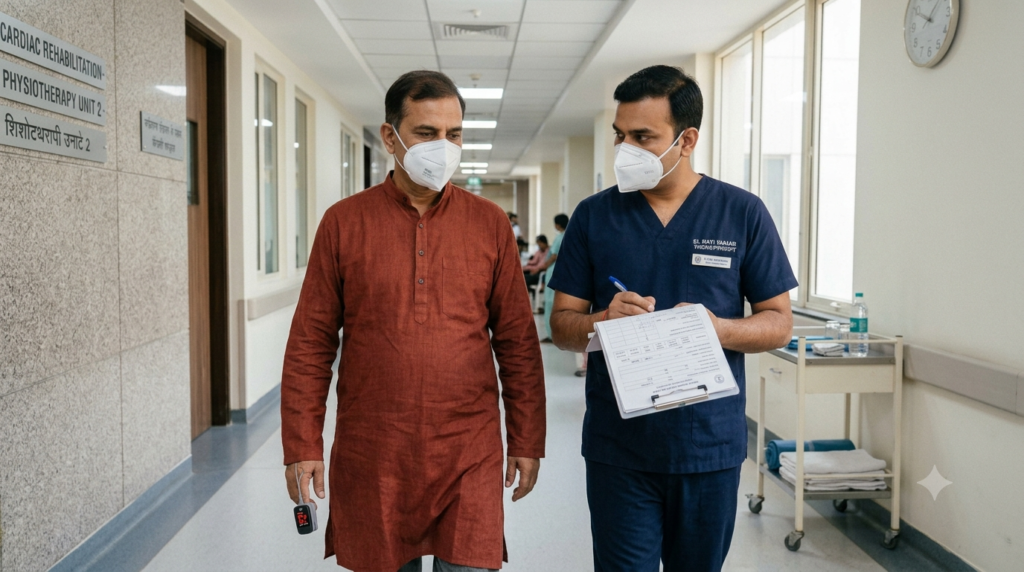
Assessment of breathing pattern and exercise tolerance Observation of how the chest, diaphragm and accessory muscles are actually working, along with a simple walking test to establish a starting point that can be re-measured later.
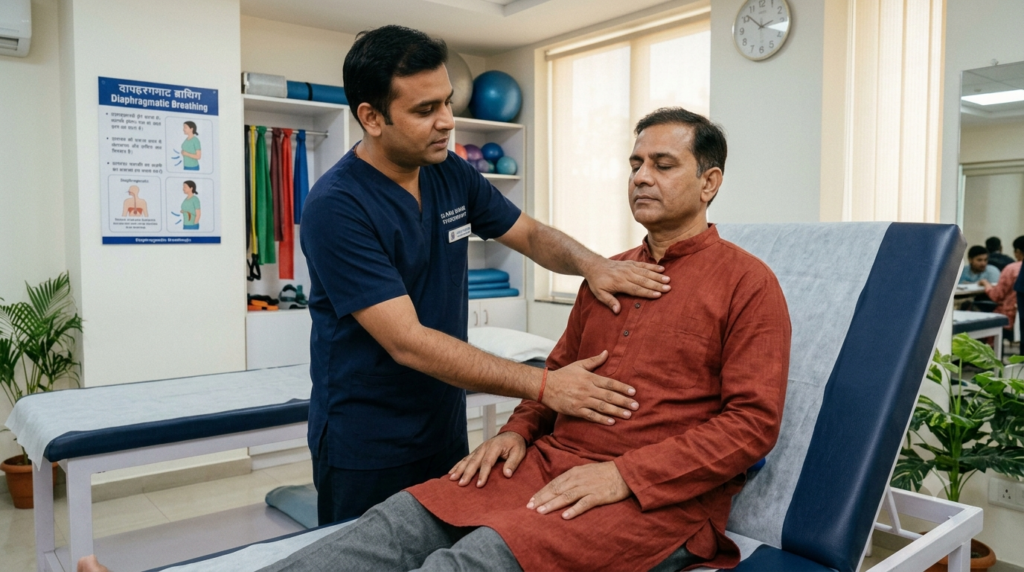
Diaphragmatic and pursed lip breathing retraining Practical technique work to slow the breathing rate, use the diaphragm properly, and control breathlessness during exertion instead of panicking through it.
Airway clearance techniques Positioning, controlled huffing and active cycle breathing to move secretions with less effort than repeated hard coughing, taught so it can be used independently at home.
Graded exercise conditioning Walking and strengthening progressed slowly against measured tolerance. Progress is deliberately conservative at the start, since overshooting once tends to set confidence back by weeks.
Posture and chest wall mobility work Manual therapy and mobility work through the thoracic spine and ribs, which is often relevant where long standing neck and upper back stiffness has restricted chest expansion.
Pacing, energy conservation and education Strategies for spreading activity through the day and recognising early warning signs, applied the same way as in cardiac rehabilitation at the clinic.
Pulmonary Rehabilitation Near La Residentia and Prateek Grand City
The clinic is located in Sector 1, Greater Noida West, behind Ace City and Stellar Jeevan Society, a short drive from La Residentia, Rudra Palace Heights, Prateek Grand City and Charms Castle. Breathing related referrals here follow a seasonal pattern that will be familiar to anyone living in the region: a noticeable rise through the winter months when air quality drops and existing airway conditions flare.
For patients with a confirmed diagnosis, the team works from the treating physician’s plan, adjusting exercise intensity around medication changes and any recent hospital admission.
📍
View location on Google Maps
Tap to open directions
Shop No. 14/15, Gyanendra Jeevan Complex (Walking Street), Behind Ace City & Stellar Jeevan Society, Sector 1, Greater Noida West – 201306
Frequently Asked Questions: Chest Physiotherapy Near Sector 1
Who is the best physiotherapist near La Residentia and Charms Castle for breathing problems?
Dr. Mukul (PT) runs breathing and chest rehabilitation at the clinic in Sector 1, Greater Noida West, working alongside the patient’s treating physician rather than in place of prescribed medical treatment.
Can physiotherapy actually help breathlessness?
It can, though not by changing the lungs themselves. Breathing retraining improves how efficiently air is moved, airway clearance techniques help shift secretions, and graded exercise raises the level of activity possible before breathlessness sets in. That combination is well established in pulmonary rehabilitation.
What is pulmonary rehabilitation?
A structured programme combining supervised exercise, breathing technique work, and education about pacing and symptom management. It is used for long term lung conditions and for people whose stamina has dropped after a chest infection or hospital stay.
Is chest physiotherapy useful after pneumonia or a bad chest infection?
Often yes, particularly where a cough is not clearing effectively or where weeks in bed have left the person deconditioned. The rebuilding phase follows the same logic as recovery after surgery, starting well below capacity and progressing steadily.
Does poor air quality in Delhi NCR make this worse?
Winter air quality in the region is a recognised aggravating factor for people with existing airway disease. It does not change the treatment approach, but it does change the practical advice about when to exercise outdoors and when to move sessions indoors.
Do I need a pulmonary function test before starting?
Not necessarily to begin, though a recent test or a physician’s diagnosis is helpful for setting safe exercise limits. Anyone with unexplained or worsening breathlessness should be medically reviewed first.
How do I book a session?
Call +91 8130036806, message on WhatsApp, or contact the clinic through the website to arrange an assessment. Recent reports and the current inhaler or medication list are worth carrying along.
Book a Chest Physiotherapy Appointment in Sector 1, Greater Noida West
Getting winded on the stairs is easy to accept as inevitable. Frequently it is not. Where the limit is set partly by breathing pattern and lost conditioning rather than by lung damage alone, structured rehabilitation moves that limit outward, sometimes considerably.
Learn more about the clinical team or get in touch to discuss a breathing assessment at Prem Advance Physiotherapy and Rehabilitation Center.
Shop No. 14/15, Gyanendra Jeevan Complex (Walking Street), Behind Ace City & Stellar Jeevan Society, Sector 1, Greater Noida West – 201306 · +91 8130036806 / +91 8750529606 · WhatsApp · Contact · Services · Find us on Google Maps